

Next Forge
Next-Forge provides a robust Turborepo starter for Next.js, designed to accelerate SaaS application development with pre-built, production-ready features.
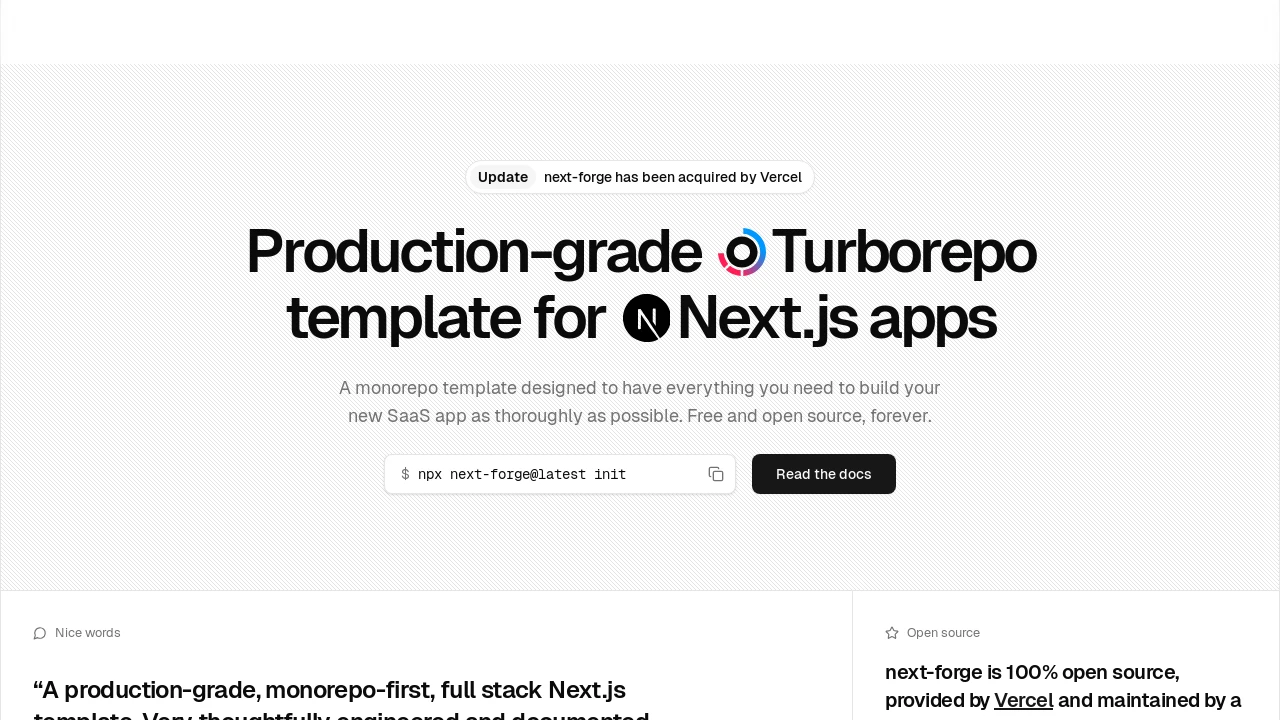
Next-Forge: Production-Grade Turborepo Template for Next.js SaaS Applications
Next-Forge is a comprehensive, open-source Turborepo template specifically designed for building production-grade Next.js applications, particularly SaaS products. It provides a robust, opinionated foundation with pre-configured essentials, aiming to streamline development from initial setup to deployment. With Next-Forge, developers get a head start on building scalable web apps, minimizing boilerplate and focusing on unique features. It's engineered to integrate a wide array of tools and best practices out-of-the-box.
Features:
- Monorepo Structure: Efficient multi-package project management using Turborepo.
- Authentication: Pre-configured user authentication (e.g., Clerk).
- Database & ORM: Integrated database setup with a type-safe ORM (e.g., Prisma).
- Payments Integration: Ready for payment processing solutions (e.g., Stripe).
- Documentation Site: Auto-generated documentation from markdown files.
- Blog System: Built-in type-safe blog functionality.
- Observability (o11y): Tools for application monitoring and logging.
- Analytics: Integrated analytics platforms (e.g., Google Analytics, PostHog).
- Email System: React-based email templates and sending (e.g., Resend, React Email).
- Feature Flags: Support for managing application feature flags.
- Dark Mode: Out-of-the-box dark mode UI support.
- API Microservice: Template for building cross-platform APIs with webhook handlers.
- UI Components & Styling: Utilizes shadcn/ui and Tailwind CSS for modern UI.
- Storybook Integration: For isolated UI component development and testing.
- In-App Notifications: Support for in-app user notifications (e.g., Knock).
Summary:
Next-Forge offers a production-ready Turborepo template for Next.js, accelerating SaaS development by providing a pre-configured monorepo with essential features like authentication, database integration, payments, and UI components. It aims to equip developers with a comprehensive toolkit, including documentation, a blog, analytics, email handling, and more, all built on modern technologies and best practices. This allows teams to quickly bootstrap projects and focus on building core application logic rather than foundational setup.

Similar to Next Forge:
 SERP BLOCKS

